


Back to School: Is Your Child’s Body Ready for the New School Year?
01 September 2026
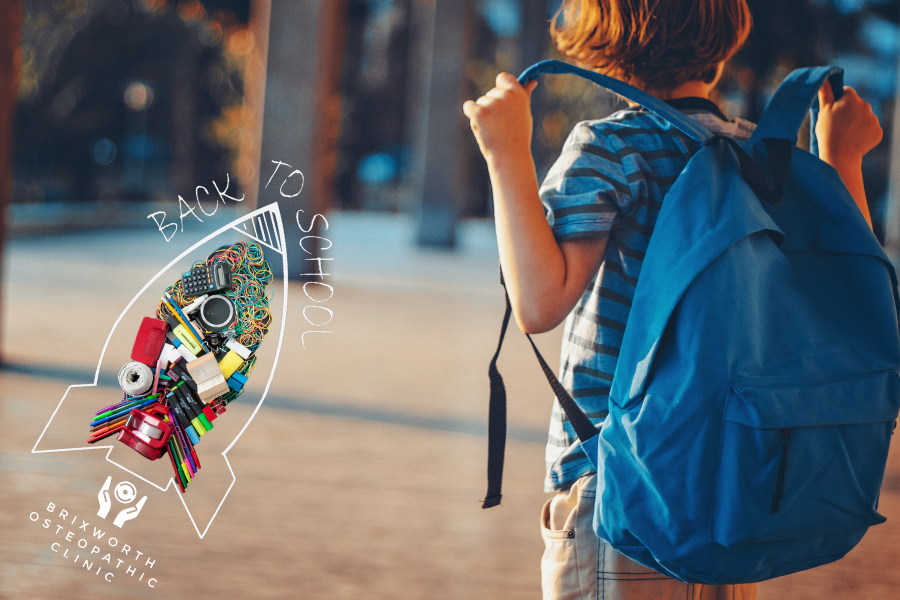
The summer holidays are flying by, and before we know it the school shoes will be back on, uniforms will be ironed (hopefully!) and school bags will once again be packed and ready by the front door.
Going back to school is a big change for children – not just mentally, but physically too.
After weeks of relaxed mornings, outdoor play and perhaps a little more screen time than usual, suddenly there’s sitting at a desk, carrying a school bag, using computers and tablets, doing homework and spending long periods in one position.
So, as we get ready for the new school year, it’s worth giving a little thought to your child’s posture and how their body is coping with all these everyday activities.
Sitting at a school desk
Children can spend a significant amount of their day sitting, whether that’s in the classroom, doing homework or using a computer.
The aim isn’t to expect children to sit perfectly upright all day – our bodies are designed to move! But a comfortable, well-supported sitting position can help reduce unnecessary strain on the neck, shoulders and back.
Ideally:
- Their feet should be supported on the floor or a footrest.
- Their bottom should be towards the back of the chair, with their back supported.
- Their knees and hips should be comfortably positioned, rather than sitting twisted or perched on the edge of the chair.
- They should be able to sit close enough to the desk without having to lean forwards.
- Their screen should be positioned so they aren't constantly looking down.
And perhaps most importantly, encourage movement.
Getting up regularly, stretching, walking around or simply changing position can make a big difference. NHS guidance for children also recommends regular changes of position and breaks from screens.
What about homework and computers?
As children get older, computers and laptops become an increasingly important part of schoolwork.
It’s very easy for a child to start off sitting nicely at the desk, only to gradually slide down the chair, lean over the laptop and end up looking like a little question mark!
If they're spending a lot of time at a computer, check that the chair, desk and screen are suitable for their size. Encourage them to change position regularly rather than staying in exactly the same posture for long periods.
The same applies to tablets and phones. Looking down at a screen for extended periods can put extra strain on the neck and upper back.
A simple rule is look up, move around and change position regularly.
The school bag challenge
Then there’s the school bag!
Books, lunch boxes, water bottles, PE kits, pencil cases… somehow it all adds up.
Carrying a heavy bag, particularly on one shoulder, can encourage a child to lean or tilt to one side. NHS advice recommends using both straps of a rucksack, adjusting them so the bag sits close to the body, and avoiding carrying unnecessary weight.
A few simple things to check:
✔ Use both shoulder straps rather than hanging the bag from one shoulder.
✔ Adjust the straps so the bag sits securely and close to the back.
✔ Pack the heaviest items closest to the body.
✔ Have a regular clear-out! Remove anything that doesn't actually need to make the journey to school.
✔ Use lockers where possible so children aren't carrying everything around all day.
Some NHS guidance suggests keeping a school bag to around 10% of a child's body weight.
And if your child is struggling to put their bag on, is leaning forwards when walking, or complains that their shoulders, neck or back hurt while wearing it, it’s worth taking a closer look at the weight and fit.
Growing bodies need to move
Children and teenagers are constantly growing and changing, and growth spurts can sometimes be accompanied by aches, stiffness or changes in the way they move.
That’s why keeping active is so important.
Walking to school, playing outside, cycling, swimming, dancing, taking part in sport – it all counts. Strong, active bodies are generally better equipped to cope with the demands of everyday life.
We don't need to worry about making every movement “perfect”. Children should be encouraged to move, play and enjoy being active.
How can Osteopathy help?
At Brixworth Osteopathic Clinic, we see children and young people for a range of musculoskeletal problems.
Osteopathy looks at how the body is functioning as a whole, rather than simply focusing on where something hurts. If your child is experiencing aches or pains, stiffness, discomfort associated with their posture, or problems that are affecting their everyday activities, an Osteopath can assess how they are moving and help identify areas that may be contributing to the problem.
Treatment is adapted to the individual child and their age, and may include gentle hands-on techniques, movement advice and simple exercises or changes that can be incorporated into everyday life.
Sometimes, the answer isn't about sitting up straighter or telling a child to “fix their posture” – it’s about helping them understand how their body feels, encouraging movement and making small changes that are realistic for them.
A little check before the school year begins
So, before the school gates open again, why not have a quick look at:
The school bag – Is it too heavy? Is it being worn correctly?
The computer set-up – Is the chair and desk suitable for your child’s size?
The sitting position – Are their feet supported and are they able to sit comfortably?
Screen time – Are they taking regular breaks and changing position?
Activity – Are they getting plenty of opportunities to move and be active?
And finally, listen to what your child is telling you.
If they regularly complain of back, neck or shoulder pain, headaches, stiffness or discomfort when sitting or carrying their school bag, don't simply put it down to “growing pains” or the demands of school.
Sometimes a little bit of support can make a big difference.
Here's to a happy, healthy and hopefully slightly less stressful start to the new school year!
If you're concerned about your child's posture, movement or aches and pains, the team at Brixworth Osteopathic Clinic are happy to help.